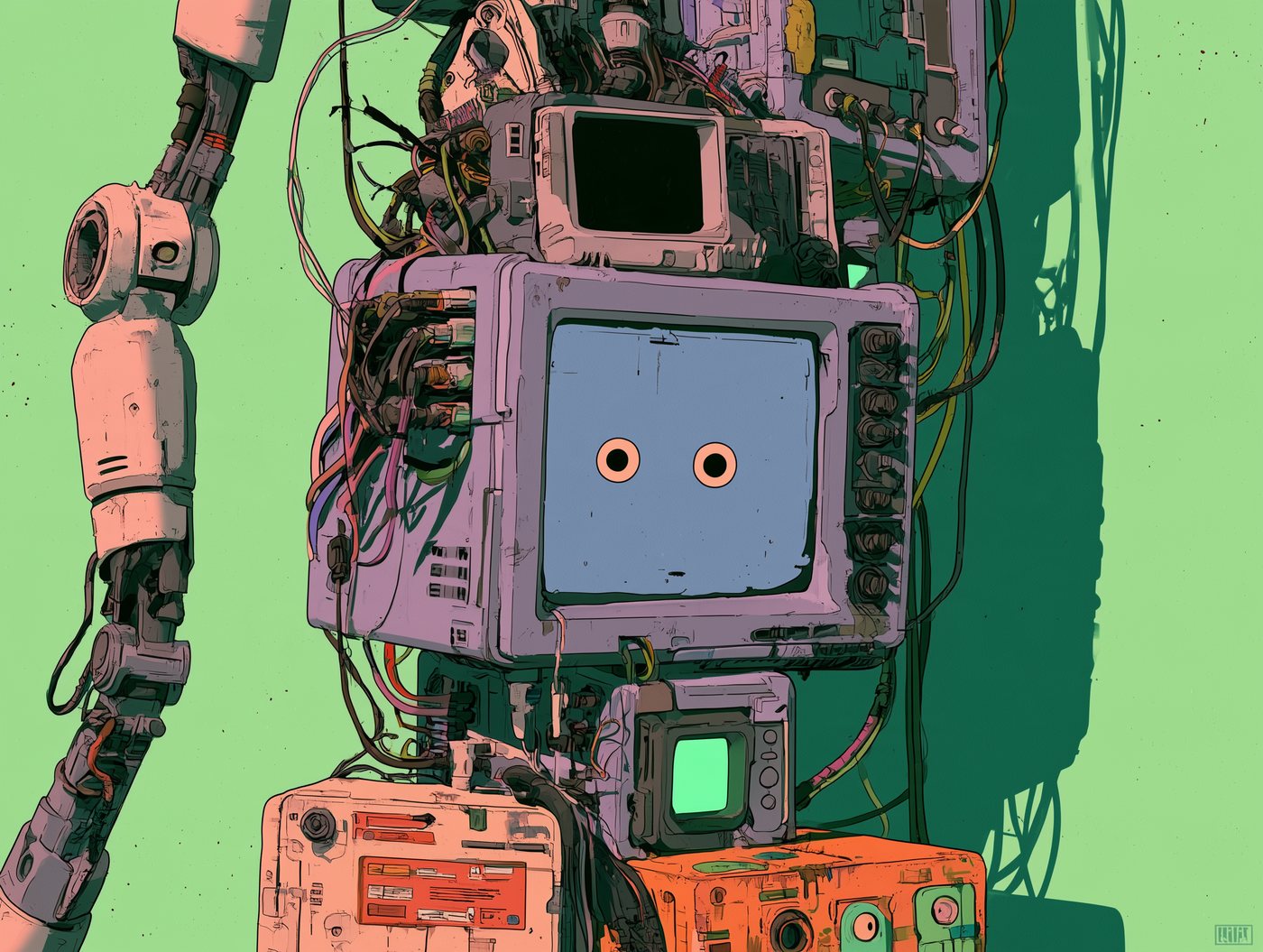
Missing "thereness" in current models
~Embodiment load-bearing to employment statistics?
There's a sense in which this graph is clearly bullshit:
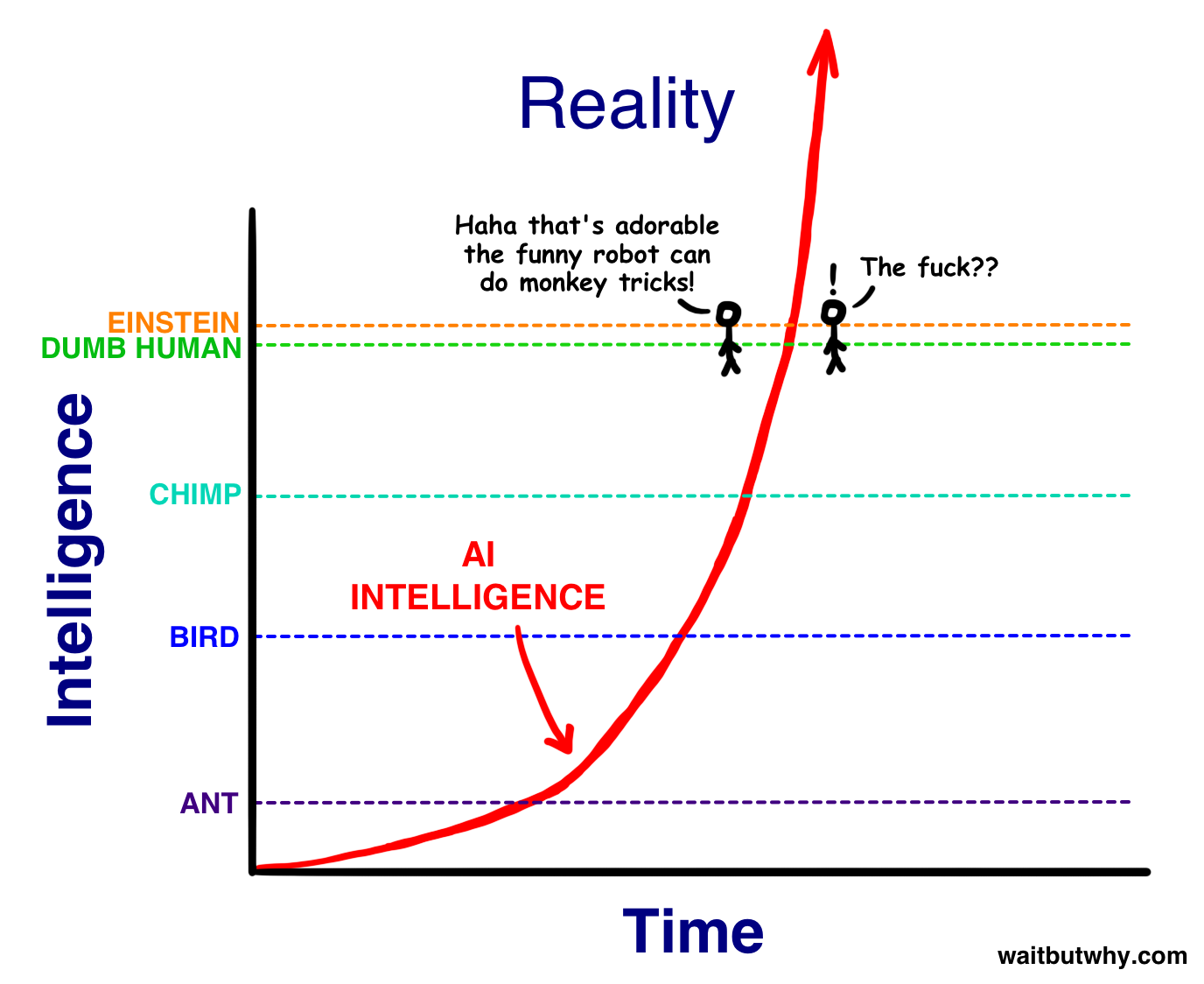
Where for one thing, we have AIs capable of solving Navier-Stokes in swarms but are also adorable—lacking some element of common sense, having a short attention span, growing overly delighted at certain projects, silly internal chain of thoughts, etc. And for another thing, there's clearly ways in which a chimp intelligence beats an LLM, and that this chart's linearity fails to capture the strangeness and orthogonality of machine minds that makes the delta between their mind-shapes and —> chimps’ greater than the delta between human mind-shapes and —> chimps’.1
At ratcamp, I co-led a project in which we bought a sound board and hooked it up to 8 microphones and 4 speakers, coded up an interface for communicating with 4 LLMs, and then played Blood on the Clocktower with 8 human participants and the bots.
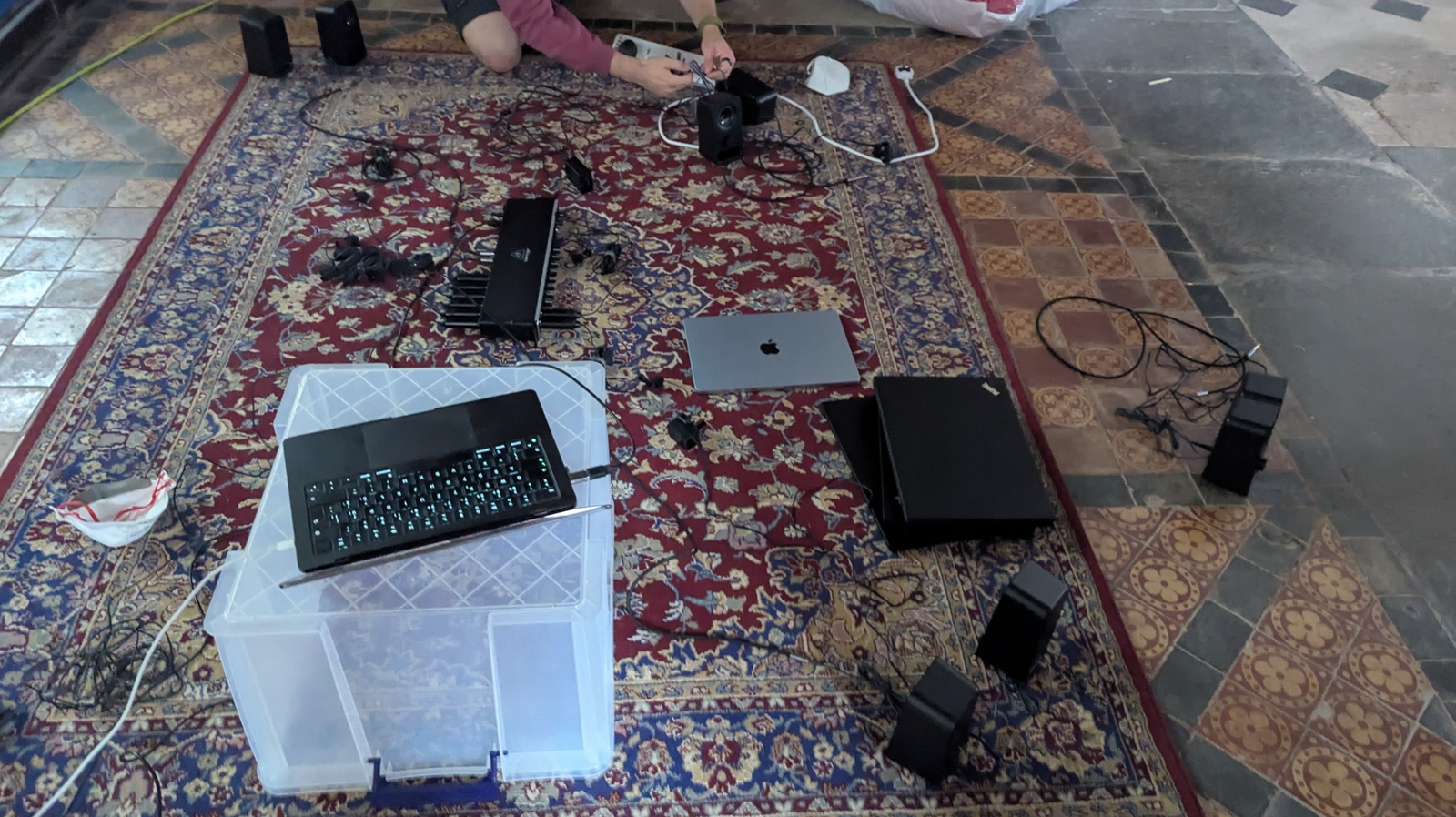
Part of the point of this project, as far as I was concerned, was seeing how “embodied” LLMs could feel for everyone else, if you gave them plushie bodies on chairs interspaced between students, pinged them every 30 seconds so they'd be caught up with the discourse, allowed them to speak at any moment, and gave them the tool calls necessary to have full player powers just like every human at that table. We repeatedly emphasized to the humans that these were players in the same right they were. Alas. Groups that went through this differed in their behavior, but one common strain was that the LLMs would get interrupted, spoken over, treated as manipulable, or outright ignored by certain students. Most didn’t use the laptops we had strewn about the church to allow them to communicate 1-1 with the agents.
What gives? Perhaps you need even more embodiment: part of that sensation of “someone is there” that hindbrains generate might be directly related to “this person could physically interact with me”. An LLM feels lesser than a chimp in some dimensions because the chimp can physically make tools and also rip your arm off and eat it.
Or perhaps you need the LLM to be a node in your social network, or a potential node in your social network: so if you know the game you're playing with them isn't iterated—like it is with every human in your social network—you're less likely to be interested. Worse: you wouldn't see them as ever being able to join your social network, which could explain why you feel human strangers are “there” but not LLMs. The answer could be more mundane: the LLMs couldn't answer in real time, experienced a delay of about 40 seconds, and lacked the capacity for body language or interrupting people in real time. If we had LLM-level intelligences with that level of immediate thereness, this problem might not exist.
Even as current models have far more agency than they did a year ago, see METR graph, they seem to lack a component of presence that could in part explain why we're not seeing massive job loss yet. Perhaps this presence has to do with embodiment, in which case an LLM on a unitree could capture that? Astra 6 in a unitree walking around the office, sitting at a cubicle or chatting by the water cooler—would that contribute to the feeling that they'd count as a whole discrete intern in a way LLMs do not feel to me right now? Combine this with a well-designed memory system that'd allow it to have a consistence personality presence like certain agents on BlueSky like Astra's (no relation) Kira, and you might solve for the persistence social network part. Use models like Taalas’ Llama 3.1 8B to chat in real time while a smarter model orchestrates long term reasoning, opinions, direction of thought. Attempt to make a human-shaped intelligence using machine parts, and you might get pretty far.
Would this change anything? Would companies be more willing to replace an intern with one of these? Is THIS what AIs are missing today, that human-intelligence shape that would make diffusion into the economy effortless? Or does the intern still have some kind of pizzazz that'd be hard to replace? Perhaps the intern is a mind capable of making the correct decision in a few narrow fields (like social interactions, long-term thinking, whatever) at least a few times a day, and these things are SO important that you can't just fire the intern? And in that case you have a jaggedness frontier that currently eludes the labs and benchmarks, which for gradual disempowerment reasons we may not want to pursue.
Btw in case you're wondering, the LLMs consistently had a better model of the game than the students, identified the imp far sooner than anyone else, had the correct sequence of events in mind, and the player that saved the day two nights in a row by slaying the imp was… Kimi K3.