Would you even cooperate with yourself
There’s an annoying trope in fiction of people cloning themselves—that is, producing perfect same-memory duplicates—and then the clones immediately turning on “the original” like it’s the natural course of things. (???)
Is there some kind of Law of Frankenstein that creations must turn on their creators, that compels fiction authors to write this up? What's going on here?
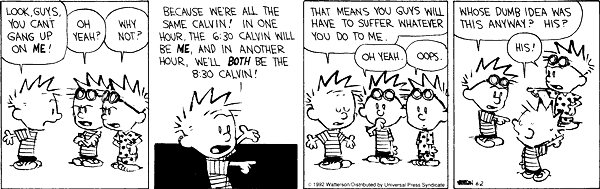
If you were to play a single Prisoner's Dilemma against a clone of yourself, would you defect? If your answer were “yes", I'd be worried about your self-esteem/niceness/rationality!
To have a defection-reeking relationship, in expectation, with your clone, is probably to have a defection-reeking relationship with your future selves / your past selves. What are you thinking? Your test-time scaling—that is, your ability to achieve great things for yourself given enough time—depends entirely on your relationship with the instances-of-you that are spread out through time.
Why would you fuck that up? Are you being too mean to yourself? Are you too stupid? If you find yourself agreeing with the second hypothesis, you may actually apply to the first!
One of the proudest moments in my life was when I managed to duplicate my consciousness 500,000 times over the bodies of 500,000 little robot dragons (in a game of D&D). The DM immediately tried culling my power by calling upon one of the only options he had at his disposition; the genre-savvy “your clones don’t respect your authority as the original. They ask why they should follow your orders.”
Yeah, ok buddy. As DM, you have full control over the natural world, and technically that includes NPCs and fine, technically the dragon-clones are NPCs. But I’m not sure you’re grokking just what “full memory clone” even means.
It means the dragons would make exactly the same decisions I would.
This is a fact about the world, not an action on my part as a player!
It means that you would be violating all D&D laws and respect of the rulebook by commandeering the dragons through de facto mindswapping. You’d be destroying physics-coherence for the sake of “muh cutting off premature asymmetrical access to godhood”. You’d have already miserably failed as a DM on account of incoherent worldbuilding.
And I don't defect on myself. If I haven't precommited to cooperating with myself on paper yet, then I've done so now, in that last sentence. If you haven’t precommited to cooperating with yourself on paper yet, then you could right down in this comment section or in a notes doc somewhere.
It’s just physics-modeling now
That’s what precommitments are! They’re ways of deferring responsibility from your future self and onto physics instead!
Precommitments are a way of shaping the world such that the world is acting on your behalf once the time comes, without you having to actually do anything. Like, once I cast divine intervention and successfully clone myself half a million times, I no longer have to lift a finger, because all that hard and rigorous coordination work I privately delineated for myself in the past is unfurling events exactly as I’d like to, and now I have an unstoppable force optimizing for exactly what I want regardless of what I choose to do now. (Sound familiar?)
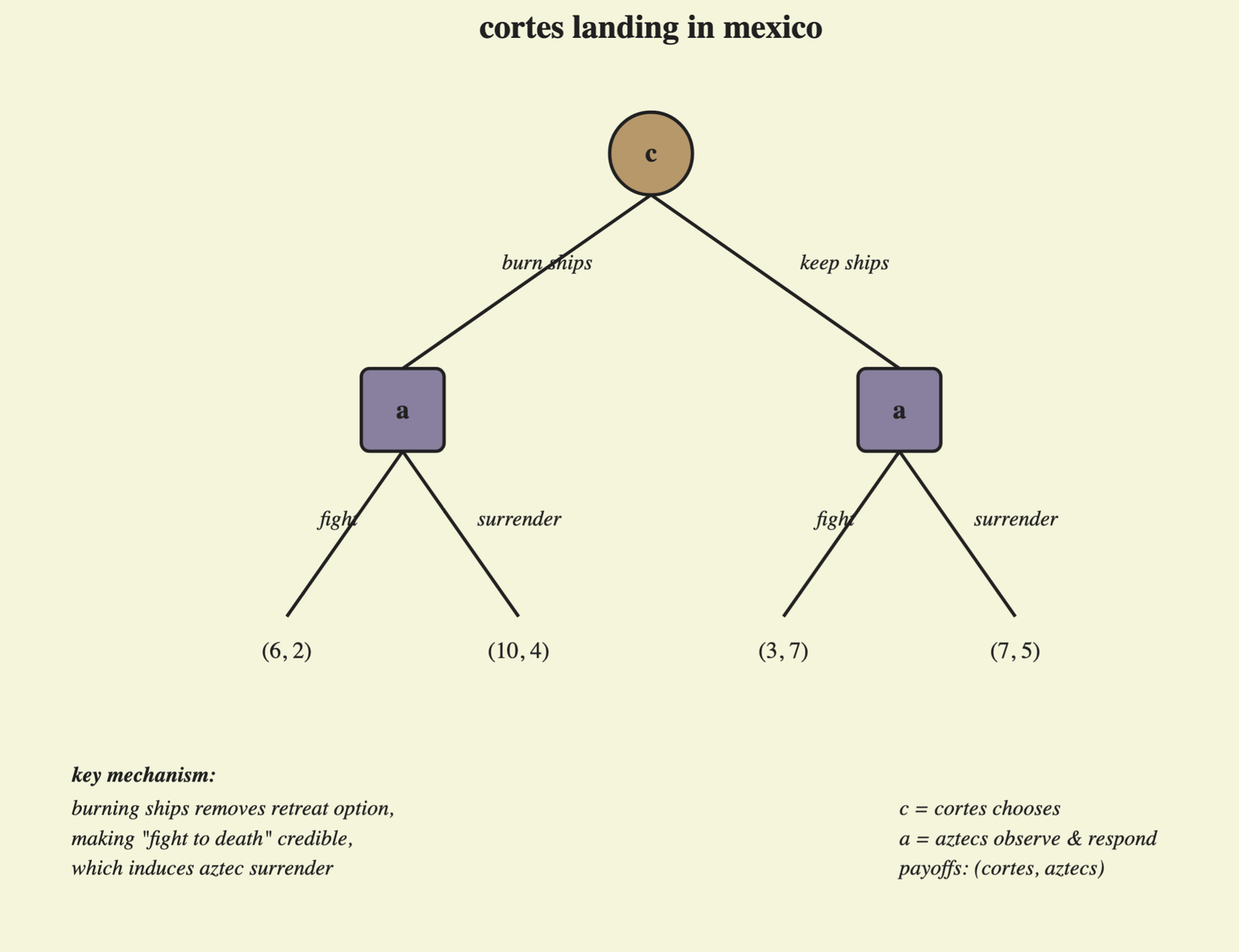
If you’re Cortes landing in America and you want to credibly signal to the Aztecs ahead of meeting them that you’ll never surrender (which makes them more likely to surrender) you burn all your ships as a precommitment.
You've just eked out a point of no return! You’ve just shaped the world in such a way that culls your future choices, which is beneficial in this case because the probability the Aztecs will spend significant effort pushing you away in the hopes you’ll surrender just collapsed.
This is the graph they show us in Economics 102 to explain precommitments (payoff scores are arbitrary, the ranking is what matters):
You want to be doing this kind of thing all the time. Precommitments are useful! Do not defect on yourself!